Wednesday, January 11, 2017

Rend your heart?

Rend your heart and not your garments, return to the LORD your God. For he is gracious and compassionate, slow to anger and abounding in love, and he relents from sending calamity. - Joel 2:13 (niv)

I have probably read this verse dozens of times. Yet, this last time I came across it, I was inspired to make a drawing based upon its imagery. So l looked up the word rend for a more specific definition, since it's not a commonly used word these days, and I wanted to make sure I portrayed it right as well. Only to be quite surprised that my presumed understanding of the word was nowhere close to the actual definition. While I am sure there are plenty of people who know that rend means to tear or rip without looking it up. I bring it up now to reveal that more knowledge, and understanding can find its way to us anytime, and in a variety of unexpected ways. 

Needles to say, the imagery was far more intense than I realized. Not to mention it refers to an action that I was familiar with, but hadn't tied to this verse before. The Hebrew practice of tearing ones clothes in frustration, the most famous Biblical example being Caiphus during the trial of Jesus. (Matt. 26:65)

Which makes this verse something the church should consider during these rather-frustrating times. What this verse indicates is a far cry from what we actually see being practiced by many in their frustrations. Things like sulking, complaining, blaming, or criticizing people. 

Rather it speaks of owning our mistakes, and allowing our brokenness to be evident before all, including God. Since it is often through our brokenness that God finds his way back in. But that won't happen if we are being over-protective of our wounds, or whitewashing ourself with false joy.

So the take away should be, when we're frustrated, look to the one thing you have the most power to change, yourself. Rather than throw it in someone else's face as garment renders did. Look also to the one person best equipped to reveal the truth behind your heartache to you, God. Don't be like Caiphus who refused to own his brokenness and blamed someone else, for his frustration. By relying only on himself rather than seek God's wisdom. Yet claiming to be doing God's work, when in reality he was only protecting his authority. A man despite all his knowledge of scripture, lacked the insight to see truth staring him in the face. 


a man revealing his brokenness to Jesus
click to enlarge

Wednesday, December 28, 2016

Success, motivation, and resolutions

We all live with the goal of being successful. We all may define it in very different ways, but in the end we are all motivated by success as we see it. Success is a concept that I've thought much about in recent days, as I have contemplated my future with Visual Parables, and my local church. One thing I have come up with is that everyone defines success in one of four broad categories. 

The first of which is passion. That is a word that often has a negative stigma attached to it, but What I mean by that is that we have beliefs, convictions, and talents; and a desire to create something, help others, or inspire people with them. When you get down to it, if we are not passionate about what we do, we are doing just enough to get by. For the truly passionate person, motivation is not about, numbers, statistics, or money. Merely the message, vision, or the creation that they live and stand by. In a perfect world, the most passionate people would always be recognized for what they intend, and be seen as the most successful people. However, the reality is that the opposite is more often the case. Since passionate pursuits are often seen as a distraction from our hunt for personal glory, acceptance, and comfort by those who follow the world's definition of success. While many would like to say that they are motivated by passion, and not these other shallow options. I seriously doubt it is absolutely true most of the time. Human nature is just that pervasive. Plus, the worlds influence is just that widespread, that it taints even good passions.

The second motivator is glory. Those who are motivated by glory seek, fame, fortune, and praise; all for the sake of their pride, ego, and vanity. Many a talented and passionate people are pushed into this, even if that is not what they want. The world has this unrelenting belief that talent belongs in the lime light. The problem is that there is only room for about 1% of the talented people in any given medium as far as fame goes. Plus, not all talented people are emotionally equipped to deal with that much attention and scrutiny that comes with fame. The movie The Soloist is a good example of this. Not to mention that the lime light is controlled by a lot of very greedy people, who are motivated by wealth, and not artistic integrity. So for those who make it to the big time, often get there by compromising their passion somehow.

Which leads to our third motivator, comfort, which can take on many forms. Many equate wealth with comfort, provided it is merely received and not worked for; which isn't very realistic. For others, it's about an absence of drama. They get on top of their world by shielding themselves from stress, challenges, criticism, and being questioned. For others comfort is relational, it's all about being loved, or at least as close a facsimile to love they can manage to manufacture.

Many people who seek comfort, for comforts sake often find just the opposite. Those who want the world to revolve around their comfort, often invite a lot of scrutiny in doing so, which is the last thing that they want. Those who seek comfort in love often take on many unloving characteristics; like impatience, unkindness, rudeness, and criticism in order to seize control of how they are loved. Yet, they often end up destroying the love they seek by doing so, and breaking their own heart in the process, but will always blame someone else for it. Those who seek comfort in wealth often live in absolute fear of losing their fortune for which they place all their hope. Which robs them of their peace as they strive to maintain their success, rather than enjoy it.

The fourth motivator is acceptance, which can very much overlap with love based comfort. We all have a run in with this at some point in our lives, especially in our adolescence as we seek validation through approval. In those critical years that we should be discovering whom God made us to be, we are merely imitating one another for the sake of acceptance. The worst part is that many never grow out of it. I contend that so many people suffer mid-life crises' is because they set such a poor foundation in their youth. All because they sought acceptance from the world, and not God. They let the world define them, and not their creator. It is only in mid-life do people realize that is not enough, and that they have no idea who they really are. Rejection is a reality we all face some time, but the more we look to acceptance to validate us, the more rejection will devastate us.

So what should motivate the disciple? All we have to do is look to Jesus, and examine what motivated him, and try to do the same. Was he motivated by acceptance? In John 6:60-71 it says that many of his followers left because his teaching was too hard. Yet, he made no attempt to stop them, nor did he altar his message or methods because of it. So clearly he was not motivated by acceptance. Was Jesus motivated by comfort? In Matthew 8:20 Jesus says "foxes have dens birds have nests, but the son of man has no place to lay his head." Clearly Jesus was not motivated by comfort to say such a thing. What about glory? On many occasions and in many ways Jesus made it clear that he sought his father's glory, not his own. Since his true passion was his father's glory, his father's will, his father's truth. Can you say the same as a Christian? Can your church say the same? I think we all should be asking ourselves this question in 2017.

With all that being said I would formally resolve to be motivated by righteous passion in 2017. Easy to say, but not so easy to live by when the world wants to beat you down and force you into their shallow mold. Not so easy when human nature looks to success to motivate us. Admittedly, when I started my Visual Parables venture into self-publishing, I did it partly because I believed that talent must seek the lime light to have value like so many others. Which has not always served my passionate integrity. Not that I regret doing it, for it has been revealing. It has given me better insight into the nature of the challenges that the church faces from within.  Even if that was not a goal of the project.

That insight is easily illustrated with social media, since it is a reflection of our society. It’s not casting a very pretty picture either. Being a part of it, I've experienced how hard it is to stand out in the midst of all the silly and angry posts that flood it. Yet, I've noticed that the faith based posts that receive the most attention are very vague, or simply warm and fuzzy. They mean something to those in the know, but nothing to the nonbelievers. They merely serve as a rallying point for Christians. So nobodies knowledge, understanding, or passions are expanded at all. What does that say about the church universal? I could never in good conscious resort to such shallow means of soliciting "reactions" for the sake of glory or acceptance. Which means mission based pages like mine have to spend more and more boosting their posts to make sure their audience actually sees their message. But are we doing it for Christ like passion, or just the vanity of worldly success. 

So that means, you may not be seeing as much of me in 2017.  Not that I will be abandoning Visual Parables. I just won't be making Facebook CEO's wealthier by boosting my posts this upcoming year. I’ll let God use my messages as he wills, not as my pride desires. I won’t be judging my success by the number of “Likes” I get. However, if you want to ensure you see my posts, click on "see first" under "following."

Facebook screen shot
click to enlarge


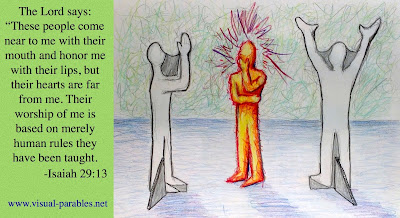
The Visual PARABLEist

a man perplexed by two cardboard cutouts worshiping
click to enlarge


Thursday, December 1, 2016

Unchurched

The buzz word "unchurched" has been going around a lot these days. It refers to an ever increasing group of believers that are abandoning the church. Not because their beliefs have changed, But rather they are fed up with the churches one size fits all ways. They are tired of the impatient, unkind, rude, and critical ways church people sometimes use to maintain that singular approach. As well as the feeling that they have no place within the traditional one note church body. 

Granted, the "unchurched" can often be just as rude and unkind as the traditionalists when pushing for their preferences. Often, they are just trying to shift from the current narrow focus to a different narrow focus, rather than seek true unity in diversity in worship. Many on both sides of the fence just want their preferences to be top priority, and all others to be dismissed. So there is plenty of blame for the faltering state of the body of Christ to go around.  Let me address the idea by offering this quote.

In looking backward, our primary concern is not to rediscover old methods to apply without change to today's needs. The value of the past for us lie not in old methods so much as enduring principles and in the ideals that have inspired generations of devout living, self-sacrificing service, and undying loyalty to a challenging cause. Conservative in matters of principle, the Apostle Paul urged Timothy to "guard the truths" entrusted to him; and yet in method Paul was so flexible and progressive that he would become "all things to all men" that he "might by all means (methods) save some."* Methods may be altered to meet present need; principles are to be maintained for all time, for "Truth is forever true." 
- Leslie Ray Marston,  Bishop and historian of the Free Methodist church
*1 Corinthians 9:22

Those are some wise words from a wise man. Words the church universal needs to take to heart. Since this "unchurched" phenomenon is likely a symptom of the immense conflict over preferences that have no doctrinal basis. Conflicts that are motivated more by comfort, convenience, and selfishness than devout living, self-sacrificing service, undying loyalty to a challenging cause, or actual Biblical principles. Although they may argue otherwise, not that many people have thought about the distinction. Since far too many people base their faith on observation, and feeling, rather than actual study.

Let me throw out another idea for you. "Cognitive dissonance" it's a psychological term which refers to that negative sensation we experience when faced with a differing opinion. A sensation which can lead to some rather irrational behavior if we choose to react emotionally, rather than act faithfully. For the disciple, it is what compels us to forsake humility in favor of pride. To choose selfishness over love. To rely on criticism rather than inspiration. It causes us to confuse preference for principle. What causes us to dismiss the unity in diversity model for the church, in favor of uniformity. It is what keeps us from living a Christ like life. It is what is tearing the church to pieces. 

All these choices I mentioned are very common and natural human responses. However, a disciple should seek to be better than that. The apostle Paul often talked about "bearing with one another" in our levels of spiritually maturity. Yet, if this "unchurched" phenomenon has taught us anything, it is that far too many in the church are not willing to bear with one another over anything, but rather push for our preferences to the point of alienating people. Which means far too many have failed miserably in selfless Christian love, humility, and ultimately the mission of the church. The question is, how are we going to rectify this?

We who are strong ought to bear with the failings of the weak and not to please ourselves. - Romans 15:1

Be completely humble and gentle; be patient, bearing with one another in love. - Ephesians 4:2

Bear with each other and forgive one another if any of you has a grievance against someone. Forgive as the Lord forgave you. Colossians 3:13

man balancing on a puzzle piece
click to enlarge

Saturday, September 10, 2016

Rethinking Intelligence

I have studied and taught about the unity in diversity model for church found in scripture extensively and repeatedly. (Otherwise known as the body of Christ.) Mostly because the church has done such a poor job of living up to this standard. So I am always on the lookout for possible culprits in this failure, because until we get to the heart of this issue with these things, they will not change for the better. One of the big reasons I believe is due to a lack of self-awareness in our society. Which I personally find to be a sign of a severe lack of understanding of God's design and will for his creation. While I am sure there are many reasons for this, but I have recently discovered something that deserves consideration. Something that I am calling, intellectual bias, meaning that we have a very narrow and incomplete definition of what makes someone smart. Our very own educational system is actually perpetuating this bias, and it has left many people feeling rather stupid for no good reason.

For by the grace given me I say to every one of you: Do not think of yourself more highly than you ought, but rather think of yourself with sober judgment, in accordance with the faith God has distributed to each of you.  For just as each of us has one body with many members, and these members do not all have the same function, -Romans 12:3-4

For example, IQ testing, it's been a concept that has been frequently debated and contested since it's inception. Mostly because of cultural bias', but it is also biased in a way that has impacted all cultures and races. I say this because IQ testing is built upon the assumption that there is something called, general intelligence. Which means, if you are smart in general, than you are smart in every possible way. Yet, all the research into this subject has not supported this idea at all. In reality, their findings point to seven distinct branches of intelligence, and everyone has their strong branches, as well as weak branches. How your specific branches are configured, says a lot about whom you are as a person, and whom God made you to be.

First, there is linguistic intelligence, which is one of very few of these elements found in IQ tests, and constitutes around half the focus of most college entrance exams. People with linguistic smarts are gifted in language, and have the ability to speak very fluidly, and at least come off as intelligent. But being intelligent in general, requires more than merely sounding eloquent. They also grasp grammar rules more easily than others. People with very linguistic brains when viewing the world through the Ivy League worldview may assume they are smarter in general than people with poor grammar skills, but that is not necessarily true. Their strength of mind just lies in branches other than linguistics.

Second there is logical intelligence, the ability to explore patterns, and solve problems, an analytical form of intellect. What IQ tests and college entrance exams typically define as the other half of what they think of as smart. Logical intelligence often manifests itself with strong math, and or scientific skills. Depending on weather your logic leans towards the abstract or the finite.

Third there is interpersonal intelligence. We may not think of this as a product of intelligence, however, there is far more mental analysis that goes into understanding and interacting with others than we realize. It is indeed a form of intelligence that some have, and others don't. If you have it, socializing and networking will be easy for you. The ease in which the inter-personally intelligent grasp this may cause them to assume it should be easy for everyone. Which often leads them to criticize the less social.
    While no standardized test covers this, but if you interview with an Ivy League school they will address it by asking about your extracurricular activities. Many of their business programs revolve around the idea that if you want to succeed in business, then you need to be able to convince people you have better ideas. Not produce better ideas, but convince people they are better. Which requires interpersonal intelligence.

However, our educational systems definition of a well rounded student stops here. They do not directly address any of these other elements, so if your strongest intelligence branches lie elsewhere, you just don't qualify as smart in their eyes. Even when they are teaching subjects like art and music, they typically address it from a logical standpoint, rather than an intra-personal one, as the actual artists and musicians they are studying do. This influence has infiltrated all of society, and it has left a lot of people feeling left out and without a good sense of self.

Forth there is kinesthetic intelligence, what we often call coordination. Again, there is a lot more mental analysis in this than we often give it credit. It's easier to just label these people dumb jocks since they often lack in branches of intelligence that our biased educational system considers smart. Kinesthetic intelligence is also useful in the ability to build things. While such abilities may be held in valued esteem in some circles, just not what we call so-called smart circles.

Fifth there is musical intelligence, which should be obvious enough. It really does have its own separate and distinct branch within the minds of people.  Let me use this as an example of how different branches can work together. If you are high in both musical and kinesthetic, you would probably be well suited as a technical performer. But, not necessarily a composer, which would require the intra-personal branch to complement the music branch. While the best of the best may be held in high regard, there is a lot more who live under the negative stigma of, musician, in the secular world. They are often held in higher esteem in the church, although it is very difficult to make a living via Christian music. So even if the musically intelligent have a calling for it, one may avoid it, to live up to the world’s standards.

Sixth there is spacial intelligence, which is the ability to imagine, and visualize in 3 dimensions. This is what is needed to design and create artistically. Like so many of these branches we just see them as talents with no intellectual properties to them at all, but it is just not true. One of my art professors said it best. "Art is insignificant to most people." So that makes spacial intelligence insignificant to most people, including within our educational system. A brand of intelligence that our world often discourages pursuing.

Finally, there is intra-personal intelligence, which is about self reflection, the ability to understand and analyze themselves objectively; the polar opposite of interpersonal. I think this is best-explained this way. Intra-personal intelligence is what turns a writer into a poet, rather than a journalist, or editor. This is what makes an artist an abstract expressionist, rather than an illustrator, or commercial artist.
    These are the people who could teach us the path to true self-awareness, rather than the reckless self-indulgence that the world passes off as self-aware. The people that can actually lead us toward living out the body of Christ concept. But not if they make those who have lesser skills in self awareness feel stupid. Yet, these are the same people who society looks upon with the most disdain, the people we label as shiftless dreamers. Is it any wonder there is such a lack of true self awareness when society looks down upon those who have it.

Can you see how the world has a set of bias' concerning intelligence, and the skills that go with it. Also, how the church may have its own set of bias' on the gifts and talents that come with our individual minds as well. A bias that makes sure that certain people are placed at the top of the heap, which places other people at the bottom.  Doesn't the world need all of this, not just the three branches that the Ivy League uplifts? Doesn't the church need all of this as well, shouldn't the church make room for all of this, rather that merely living by a few people's preferential ideas of what kind of Abilities are important? Where is the Christian love and humility in intellectual exclusion? Where is the body of Christ within this kind of thinking? As a multiple amputee that can't hold itself up anymore I would say. 

The Visual PARABLEist

a man concentrating so hard his mind is swelling
click to enlarge


Wednesday, August 24, 2016

Nation of Rage

Have you ever heard the term "the framing effect?" If not, what it all boils down to is that people tend to rate the value of information they receive from others, by the way that it is presented, rather than by its actual content. So if someone communicates a message negatively with hatred and anger, they won't likely consider a word you say. They can't get past your hateful rage in order to look at the message objectively. Yet, this methodology of using anger in a vain effort to give our words power is being used quite often, especially in social media. However, people are not seeing how they are in reality having quite the opposite impact that they want in swaying the opinion of others. The illusion that they are producing positive results is very real in their eyes though. Since negativity can seem very positive to those who share the same feelings of anger over a given subject. It gives a voice to their anger, and people very much feel validated when their emotions are acknowledged. So anger often just becomes a rallying point, so people can gang up on the people with differing opinions that threaten us. So we don’t feel all alone in our opinion. In the end, anger is ultimately increased and intensified to dangerous and explosive proportions this way. Yet, the intended message or reasoning behind that anger just gets all the more lost and obscured, regardless how valid it may be.

Of course, when we believe we are right, we think it excuses us from having to listen. But, how are we supposed to convince anybody without anger, if we don't first seek to understand their point of view? Since they just might think that they don’t have to listen to you either. Someone has to step up and do the right thing first, if not the disciple, then who will? Of course, you have to have true understanding of your beliefs to talk about them reasonably. Then again, maybe this is why many are so prone to resorting to anger, it is all just a feeling for them.

So let me ask you this, what methods do you present your message of truth?

My dear brothers and sisters, take note of this: everyone should be quick to listen, slow to speak and slow to become angry, because human anger does not produce the righteousness that God desires. -James 1:19-20

But in your hearts revere Christ as Lord. Always be prepared to give an answer to everyone who asks you to give the reason for the hope that you have. But do this with gentleness and respect, -1 Peter 3:5

The Visual PARABLEist

a person responding negatively to an outburst of anger.
click to enlarge

Saturday, August 20, 2016

Idleness

But in fact God has placed the parts in the body, every one of them, just as he wanted them to be. -I Corinthians 12:18

And he is the head of the body, the church; he is the beginning and the firstborn from among the dead, so that in everything he might have the supremacy. -Colossians 1:18

They have lost connection with the head, from whom the whole body, supported and held together by its ligaments and sinews, grows as God causes it to grow. -Colossians 2:19


a paralized body looking its head and heart on a pedestal.
click to enlarge

The above drawing was inspired by a story that a pastor told me. About a person who walked into his office unannounced, and opened with the phrase "what are you doing to build up this church?" While he offered no specifics or even a name. It was obvious he had some concerns over this person's attitude. Yet had even greater concerns that this attitude is held by more than this one individual. In all honesty, I have every reason to believe his concerns are warranted.

Granted, all believers want their church to be strong, but to what end? For God's sake, for the sake of the unsaved? Or just so that it will always be there for them, to fulfill certain needs. While the church should do what it can for its members, especially for new believers. But let me ask you this, how is the body of the church supposed to do that for many people with so many inactive parts? The church body seems very much crippled with most of its parts only there to receive, and very few parts wanting to give. But is that realistic, should so many parts of the body of the church be as willfully paralyzed as it is?

Maybe we need to have a closer look at Paul's metaphor for the church as a body, with Christ being the head of it. If Christ is truly the head of the church, he can still be active within this world if we are truly connected to him, and responding to that connection. As active as the many parts of his church body is. While Paul never explicitly says who the heart should be, many in the body put that burden upon their ministers. Not that I am saying that is how it should be, just that is how it is often applied. I'm sure I could make a better argument for the Holy Spirit being the heart of the church. Unfortunately, for many churches, the pastor is often one of very few conduits of the spirit, so the drawing works either way. The heart is certainly a critical part of the body, but it does not have the ability to bear the weight of the body. Yet, it is through heart that the body has the strength to bear its own weight. It is through strength of heart we keep from being idle. Let's face it, bodies do not thrive in idleness. Yet, ultimately this attitude I am trying to address wants their church to thrive despite their own idleness. They want to feed off of the labor of others. They want to ride on the back of the work of someone else. If that is how it really worked, Paul would have used a very different metaphor than a living body.

What seems the norm for many churches these days are that 80-90% of the work is done by 10-20% of the people. That's a rather poor power to weight ratio. I'm sure many want to believe that Jesus can pick up the slack. Well of course, he could, but why should he. If we are counting on that just so that we can take and receive, yet never have to give in a loving Christ like way ourselves, then he would be blessing selfish behavior. Enabling a behavior that drains the body of the church, rather than build it up. What we often refer to as negative reinforcement. God certainly knows better than to encourage that. Granted, it can be very hard knowing where to draw the line between our part and God's part. Knowing how faith in God, and trust in his sufficiency really apply. So let me throw these ideas out there to consider.

•Strength that is not put to use, is of no more value than idleness.
•How will we know where to apply God's strength if not for the wisdom the head of the church body offers?
•Separate, we are all imperfect, and in need of something, but we all have something to give as well. If we all focused on giving what we could to the rest of the body in love, rather than selfishly demand that our needs are met, we just might find that our needs will be met without demanding. We just might witness the church grow in strength.

The Visual PARABLEist

Now we ask you, brothers and sisters, to acknowledge those who work hard among you, who care for you in the Lord and who admonish you.  Hold them in the highest regard in love because of their work. Live in peace with each other.  And we urge you, brothers and sisters, warn those who are idle and disruptive, encourage the disheartened, help the weak, be patient with everyone.  Make sure that nobody pays back wrong for wrong, but always strive to do what is good for each other and for everyone else. -1 Thessalonians 5:12-15

Saturday, July 16, 2016

Mere Appearances: John 7:24

It can be very easy to get caught up in the obvious things that glare out in front of our faces, in how things appear. Since that is what is easy to discern about others and situations, and what we know that other people can discern in us. However, Christians who live by scripture, should know better than to merely succumb to human nature on this one.

"Stop judging by mere appearances, but instead, judge correctly." - John 7:24 (Jesus)

When we judge and condemn by mere appearances, or on the surface, to put it another way. We are falling victim to the legalistic mind set, much like the Pharisees did two-thousand years ago. Unfortunately, many in the church are still doing this today by getting all caught up with people's behavior, but never looking any deeper. Granted, behavior can be a reflection of where our heart is at, but it doesn't tell us the whole story; it is often a symptom of a larger problem. Which is precisely why We shouldn't judge by mere appearances, it's an incomplete assessment; regardless the situation or context.

While people often sin for rather selfish reasons; there is often a lot of hurts, emotional scars, and brokenness behind our selfish and ultimately sinful actions. There's often a face behind every scar as well. So if we correct in a way that is just as unkind, rude, and critical as the faces behind their scars; it is unlikely they will take your words seriously, or see them as constructive.

As disciples we need to keep in mind what Jesus told us about righteousness, specifically, that true holiness must come from the heart. (Matt. 23:25-27) Leave out the heart and all you are doing is whitewashing yourself. If it is foolish to do that to self, how much more foolish is it to whitewash others against their will. To force people to change their behavior, but never address what lies at the heart of their actions. For example, if you pointed a gun at someone and demanded that they say "I love you" they probably will. But, if you honestly think their words are sincere, you are only kidding yourself. Such is the nature of forced obedience. That is not the kind of followers Jesus wanted. The question is, why do we?

Sin isn't any more surface than righteousness is. (Matthew 15:18-20) So if you judge someone by mere outward signs, and never consider the emotional wounds behind them; we are essentially saying, I don't care about your pain; I only care how your actions affect me. Is that how Jesus corrected, by dismissing people's pain in favor of a pleasant camouflage? No it was not. So why do we?

Consider this, psychologists will tell you that the desire for unconditional love is one of our primary motivators. So many of these obsessive, compulsive, and self-destructive behaviors are misguided attempts to manufacture those feelings. Yet, we as believers have access to the ultimate unconditional love, but when we judge people harshly and critically by mere appearances, we are misrepresenting that love as conditional. We are pushing people away from the very thing they need most. So ultimately we are leading people astray by poisoning people to God's love.  Jesus had some stern words for such people, do yourself a favor and don't be one of them. (Matthew 18:6-7)

Let me ask you this, how do you respond to people judging you with impatience, unkindness, rudeness, criticism, and disrespect? Does it inspire you to change or just resist and lash back? If it does inspire you to change, is that change sincere, or is it merely based on fear? Other people will not likely respond any differently when you use said tactics on them. Keep all this in mind the next time somebodies mere appearance rubs you the wrong way, and you are tempted to alter their surface behavior for the sake of your comfort. 

The Visual PARABLEist

A man looking at one side of an object and assuming it is symetical, when it is not.
Click to enlarge