Saturday, February 2, 2019

Worship Wars


I've been a part of the church universal for decades now, and I've seen many shifts in worship over the years. So naturally I've encountered many strong opinions over these shifts as well. Unfortunately, many of these opinions are often based upon emotion, sentiment, and preferences instead of truth. Let's face it, when our objective is to gratify our feelings via our preferences, God is taking a backseat to self; which obviously isn't proper worship at all. So the subject warrants an objective look as things are starting to shift yet again.

One of the biggest shifts in recent decades was the contemporary worship movement that saw its peak in the 90's. For many critics of it, it was unfamiliar, which ultimately made it uncomfortable. Leading to many vague, but emotionally charged criticisms of contemporary worship. Which were sentimental reactions, not theological arguments. People who were all for it, found it emotionally up-lifting. While they may say it was actually spiritual and not emotional. However, many proponents of the contemporary worship movement are starting to admit that it in no way produced good disciples. Which is strong evidence that contemporary enthusiasts were confusing emotion for spirit.

The primary difference between contemporary and traditional worship is the music. Many argue that hymns are more doctrinally sound and convicting, where contemporary praise music is but fluff that doesn't go any deeper than what God does for us. These are but broad and blanket statements that may sometimes ring true, but not always. For example, the famous hymn, Come Thou Fount, is very much a song about God's provision, so it's very praise song like in its subject matter. Plus, it's not that there are not convicting praise songs that are challenging to us as disciples. It's just they are not the ones that become famous and popular. Which I dare say reflects more upon the people listening, than the style of music.

One good argument I have heard against contemporary worship, is that it functions mostly as an attractant. Which is a product of evangelism and not worship. While we need both, we shouldn’t forsake one to emphasize the other. (Luke 11:42) No matter how much we may need new converts right now. Because of the contemporary worship movement's failures, it has led many to bring back liturgical worship in recent days. Which is a very old style that predates what we often refer to as traditional worship. While people are offering many reasons for this change, the most common being, this is what millennials supposedly want. I dare say the real reason is that it dates to a time before the church started to lose its hold in our world. As if that is the only factor in this loss.

But just like any other shift, it’s unfamiliar and it violates peoples comfort zones. So we are already encountering resistance to it. One of the big arguments against it, is that it can become rote. However, you can make the same argument about hymns and praise songs. We often sing along without any conscious thought once they become familiar to us. It’s just that the emotive aspect of music often camouflages how rote it can really be. Anything can become rote if the individual allows it. That burden lies on the sincerity of the worshiper, not the worship style. Not that I don’t understand where they are coming from when they call it rote. It was not until I had to fill in for the absent pastor and the responsibility of leading people in liturgy fell on me, did the real gravity of our responsive readings really strike me. It was through practicing it in private where I was really able to meditate on the power of the liturgy, not in corporate worship. So I challenge you, before you dismiss liturgy, to bring it into your private worship, assuming you even set aside a time for that. This experience got me thinking about some of the few times that scripture reveals what worship looks like in heaven.

In the year that King Uzziah died, I saw the Lord sitting on a throne, high and lofty; and the hem of his robe filled the temple. Seraphs were in attendance above him; each had six wings: with two they covered their faces, and with two they covered their feet, and with two they flew. And one called to another and said: “Holy, holy, holy is the Lord of hosts; the whole earth is full of his glory.” -Isaiah 6:1-3

After this I looked, and there in heaven a door stood open! And the first voice, which I had heard speaking to me like a trumpet, said, “Come up here, and I will show you what must take place after this.” At once I was in the spirit, and there in heaven stood a throne, with one seated on the throne! And the one seated there looks like jasper and carnelian, and around the throne is a rainbow that looks like an emerald. Around the throne are twenty-four thrones, and seated on the thrones are twenty-four elders, dressed in white robes, with golden crowns on their heads. Coming from the throne are flashes of lightning, and rumblings and peals of thunder, and in front of the throne burn seven flaming torches, which are the seven spirits of God; and in front of the throne there is something like a sea of glass, like crystal. Around the throne, and on each side of the throne, are four living creatures, full of eyes in front and behind: the first living creature like a lion, the second living creature like an ox, the third living creature with a face like a human face, and the fourth living creature like a flying eagle. And the four living creatures, each of them with six wings, are full of eyes all around and inside. Day and night without ceasing they sing, “Holy, holy, holy, the Lord God the Almighty, who was and is and is to come.” And whenever the living creatures give glory and honor and thanks to the one who is seated on the throne, who lives forever and ever, the twenty-four elders fall before the one who is seated on the throne and worship the one who lives forever and ever; they cast their crowns before the throne, singing, “You are worthy, our Lord and God, to receive glory and honor and power, for you created all things, and by your will they existed and were created.” -Revelation 4:1-11

These scenes definitely have the earmarks of liturgy to them. That in itself is probably the best argument for liturgical worship you will ever find. Since it’s based upon examples from scripture, and not emotion, sentiment, or personal preference.

While liturgical worship may seem like a burdensome cross to bear for many. But let me remind you that Jesus told us to deny self, take up our cross, and follow him. (Matthew 16:24) So maybe it's about time we set aside the emotion, and preferences that causes us to follow self. Then start to offer true devotion and reverence for God by revealing his glory, as proper worship should. Maybe liturgy really is an effective way to get back to the true heart of sincere worship. A method that actually educates it’s followers, not just entertain them.
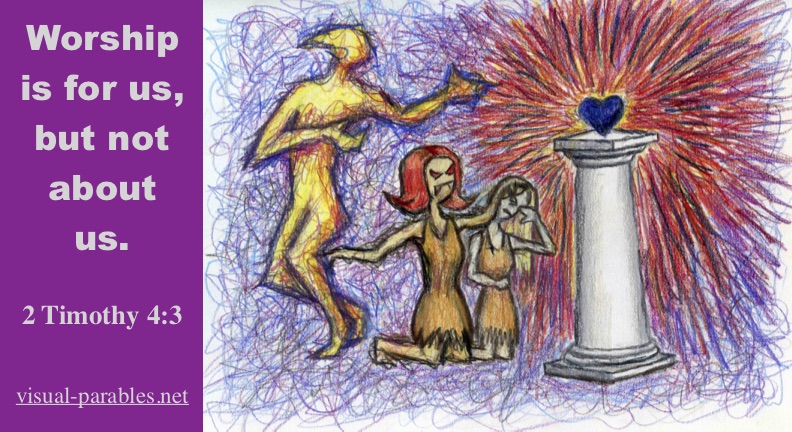

A person with fangs forcing others to worship her will
click to enlarge


Sunday, January 13, 2019

Human Nature


For those who were following my series on the human heart might have noticed I took a break from it over the Christmas season to do an Advent project. Soon, after an opportunity to guest speak came along, which I seized the opportunity to utilize some of my new found knowledge on the subject of the heart. Which you can watch for yourself at the link below. I hope to be back to my series very soon.
Human Nature

Jesus holding open a Bible as a sculptor re-carves a heart from the image.
click to enlarge

Saturday, October 13, 2018

Understanding our spiritual center

One important truth I have revealed in my series on the human heart from a Biblical perspective, is that it's our spiritual center. Spirituality isn't always the easiest thing to define, even with those of the same faith, since various people view it very differently. Yet, there may be a good reason for that, as I have recently discovered through the spirituality wheel.

The spirituality wheel breaks down Christian spiritually into four main types. Which is something we might not have not considered before, because we've assumed that spirituality is a one size fits all experience. Which would explain why there is so much conflict in the church over worship. We are assuming what arouses our spirit is somehow universal, so we feel there’s nothing wrong with imposing our tendencies on everyone, and opposing all else.

I say this because with every spiritual type there is also a danger, a weakness if you will. I have witnessed every single one of these dangers played out in churches that I have been a part of. Unapologetically I might add, which never produces fruitful results. So I believe it of incredible value to take this to heart so that we can set aside the emotions that cause us to follow “self." Then start to value others above ourselves as Jesus wanted us to. We can do this by seeking to understand one another's differences of heart, instead of just criticize those who are spiritually different from us.

Do nothing out of selfish ambition or vain conceit. Rather, in humility value others above yourselves, -Philippians 2:3

Type 1 ● Head Spirituality
This is an intellectual thinking spirituality that favors concrete rules, and the easily defined. People attracted to this form of spirituality tend to be rational and logical, valuing precision in their behavior. A real world example would be John Calvin.

Their Spiritual danger is rationalism. Expressing one's spiritual life through legalism, with a consequent loss of inner conviction, yet very condemning of others. Sometimes seen as cold and indifferent.

Type 2 ● Heart Spirituality
For the heart spiritual, God is experienced more through the heart than the head. Since God is love, their belief is that he must be known through love, not simply known through ideas. The result is a more charismatic spirituality with the aim to achieve holiness. A real world example would be John Wesley.

Their Spiritual danger is excessive emotionalism, the belief that emotion is the test of the validity of a person's spiritual experience. Often confusing emotion for the spirit. Can lead to an "us against the world" mentality that fails to recognize the spiritual experience of those in other religious traditions.

Type 3 ● Mystical Spirituality
Emphasizes the mystery of God and sees God as too big to fully comprehend fully in our small mortal state. Not that it necessarily stops them from seeking as much understanding as possible. People attracted to this type of spirituality are often contemplative and intuitive. They emphasize the process of spirituality, seeing it as a journey. A real world example would be Thomas Merton.

Their Spiritual danger is being reclusive. They often distance themselves from one size fits all cultures and institutions that try to put God in a box. Resulting in retreat from church community, and from interaction with the world. Often seen as passive.

Type 4 ● Social Justice Spirituality
Such people are active visionaries who are single-minded with a deeply focused, almost crusading, type of spirituality. Their Goal is simply to obey God by living with mission. In so doing, transform society by contributing to the establishment of God’s Kingdom. A real world example would be St. Francis of Assisi.

Their spiritual danger lies in a moralistic and unrelenting tunnel-vision that excludes or judges others who do not share their passion for putting faith into action.

Remember that the Biblical word for heart is very much associated with personality as well. So as you can see, these type definitions show us that the heart is absolutely where the spirit and personality meet.

I have said it repeatedly, but I must keep saying it until the Biblical model of church is truly achieved. The body of Christ, which is the church, is meant to be diverse. Every part having unique talents, skills, and gifts. With that comes unique needs, personality, and weaknesses as well. Which apparently extends to how we engage spirituality as well. If we do not honor and recognize that, we produce only conflict and create alienation of those who are made differently. Which is not beneficial for the unity of the kingdom of God at all. In the end, we need the "head" types to keep us on the straight and narrow. The "heart" types to remind us that the straight and narrow is meant be an act of love for God, not just an obligation. The "social justice" types to remind us that what we do, and don't do unto others, we do unto God as well. And the "mystic" types to remind us that all types are needed to create a strong and vital church that truly acknowledges the grandness of God to the best of our ability. This can't happen though if we look at the world through our emotions and judge everything through the standard of self.

Therefore, my brethren, you also were made to die to the Law through the body of Christ, so that you might be joined to an other, to Him who was raised from the dead, in order that we might bear fruit for God -Romans 7:4

If I’ve peaked your curiosity at all, the link below will lead you to a quiz to identify your spiritual type with more detailed descriptions.

The Spirituality Wheel PDF


a person seeing everything in a distorted way by looking at it though a filter of self.
click to enlarge

Saturday, October 6, 2018

Broken-hearted?


The phrase broken-hearted appears in the Bible four times. If we read these verses with the common understanding of the word heart, we will likely assume it is merely referring to emotional wounds or lost love. Yet, if we read it with the proper Biblical understanding of the word, we will realize it goes far deeper than that. With the heart being more about personality, and our spiritual center, we can see our very self is broken when our heart is.

The Lord is close to the brokenhearted and saves those who are crushed in spirit. -Psalm 34:18
Here, we see a direct correlation between heart and spirit. Do we have the same compassion for the broken as the Lord does though?

For he never thought of doing a kindness, but hounded to death the poor and the needy and the brokenhearted. -Psalm 109:16
Here, David is talking about the wicked, and how they tend to victimize the broken-hearted, instead of show compassion. What will happen to the broken-hearted if believers don't intervene?

He heals the brokenhearted and binds up their wounds. -Psalm 147:3
What the Lord wants to do with the broken-hearted, not enable or indulge their brokenness, but heal it.

The Spirit of the Sovereign Lord is on me, because the Lord has anointed me to proclaim good news to the poor. He has sent me to bind up the brokenhearted, to proclaim freedom for the captives and release from darkness for the prisoners, -Isaiah 61:1
A prophecy about the Messiah, and his mission, and how the broken-hearted fit into that. Which reveals something what it means to be truly Christ like.

Do you have a better perspective on what it means to be broken-hearted and its potential ramifications on the spirit? That if one is broken they may be unable to conceptualize the way, and the importance of the spirit; especially if they have been routinely used by the world. Why it's important to address the brokenness in the heart first, instead of start with obedience that takes a strong spirit to achieve. However, a better question would be, what are you going to do about that?

The Visual PARABLEist

A person standing on a broken heart and the cracks are running into his body.
click to enlarge

Saturday, September 29, 2018

The heart of a leader


While going through the book of First Samuel one theme in particular stood out, as far as the heart is concerned. That theme being leadership. It seems the heart of a leader is particularly important to God. In this case I think it’s best to just let the scripture speak for itself.

Stated to the high priest Eli who displeased the Lord, and right before Samuel was called to be a prophet.
I will raise up for myself a faithful priest, who will do according to what is in my heart and mind. I will firmly establish his priestly house, and they will minister before my anointed one always.
-1 Samuel 2:35

Saul was just looking for his Donkeys; Samuel was looking for the future king of Israel.
“I am the seer,” Samuel replied. “Go up ahead of me to the high place, for today you are to eat with me, and in the morning I will send you on your way and will tell you all that is in your heart.
-1 Samuel 9:19

What we see after Saul was anointed king.
As Saul turned to leave Samuel, God changed Saul’s heart, and all these signs were fulfilled that day.
-1 Samuel 10:9

Saul also went to his home in Gibeah, accompanied by valiant men whose hearts God had touched.  But some scoundrels said, “How can this fellow save us?” They despised him and brought him no gifts. But Saul kept silent.
-1 Samuel 10:26-27

What Saul was told when he lost favor in the eyes of God.
But now your kingdom will not endure; the Lord has sought out a man after his own heart and appointed him ruler of his people, because you have not kept the Lord’s command.”
-1 Samuel 13:14

Samuel was told this when looking for Saul’s replacement. 
But the Lord said to Samuel, “Do not consider his appearance or his height, for I have rejected him. The Lord does not look at the things people look at. People look at the outward appearance, but the Lord looks at the heart.”
-1 Samuel 16:7

Although David was chosen by God to be a man after his own heart, his own brothers could not see what God saw. Consider that when judging your leaders.
When Eliab, David’s oldest brother, heard him speaking with the men, he burned with anger at him and asked, “Why have you come down here? And with whom did you leave those few sheep in the wilderness? I know how conceited you are and how wicked your heart is; you came down only to watch the battle.”
-1 Samuel 17:28


a man before a double edged sword of authority within a stone shaped like a heart
click to enlarge


Friday, September 21, 2018

Melting Hearts

I started this series on the human heart because I found out the word heart in the Bible’s original languages of Hebrew, and Greek did not have the same connection to emotions as our English word does. However, we should not assume that the opposite extreme is true, that the heart has absolutely nothing to do with emotions at all. In my pursuit to look up every reference to heart in the Bible, I have found a few emotions applied to the word heart. However, so far every instance the emotion mentioned is always the result of an outside influence, a response to a situation, the emotion does not originate within the heart. Also, every instance so far has been very negative. When emotion is interjected into our hearts, it's typically a bad sign. Until I find an example of a positive emotion being interjected into the heart, I cannot comment on the possibility of a positive counterpoint.

For now let's look closer at the heart being adversely effected by emotion, specifically fear. In Deuteronomy 1:28, it points out that fear overtaking the hearts of the people kept the Israelites from entering the promised land. In Joshua 2:11 and 5:1 we see that fear has flip-flopped to the native people living in the promised land, as the Israelites again enter the land after forty years of transformation. It uses the same phrase I might add. We see the same phrase again in Joshua 7:5, and the wording and context on this one caught my eye and inspired me to write about it today. The context being that the Israelites have fallen into sin again, and for that reason have lost the Lord's favor; therefore, they lose a battle in taking the promised land.

. . . At this the hearts of the people melted in fear and became like water. -Joshua 7:5 b 

There are two prominent implications with this verse. 

1.The state of their heart was like ice, implying that it was sin that made their heart grow cold. 

2. Since the Bible word for heart is mostly indicative of personality, being afraid causes it to dissipate like melting ice. Giving into fear effectively causes us to lose ourselves.

Now let’s build upon this idea by looking at Joshua 14:8-9, where Joshua himself is talking about the past.

but my fellow Israelites who went up with me made the hearts of the people melt in fear. I, however, followed the Lord my God wholeheartedly. So on that day Moses swore to me, ‘The land on which your feet have walked will be your inheritance and that of your children forever, because you have followed the Lord my God wholeheartedly.’ -Joshua 14:8-9

Which drives the concept further by indicating that fear keeps us from doing anything wholeheartedly. No wonder the Lord did not give us a spirit of fear. (Romans 8:15) It robs us of all our strength and passion to commit to God, and his mission for us. 

Is your church only going through the motions half heartedly? Then maybe sin has caused their hearts to grow cold. Maybe that coldness has made them susceptible to the spirit of fear, and has melted their passion away, making your church as solid as water. Valid questions we should all ask ourselves not just as individuals, but collectively as a church as well. Do you have a melting heart?


a warm-hearted person among the cold-hearted.
click to enlarge

Saturday, September 15, 2018

The Heart of Obedience

Recently, I had a discussion with someone who was switching churches, and he alluded that the reason was that he was hungry for "black and white" teaching. He's hardly the first, or only person I've come across like this. The problem I have with such an attitude is that I can't fit things like salvation, forgiveness, or grace into a strictly black and white model, since nobody could be saved that way. Either the gospel would be so permissive that it would not actually be "set apart" from this broken world. Or it would be so strict that we would all be condemned.

These days you often see “black and white” Christians accusing other ministries for preaching an incomplete gospel. The irony of this is that these accusers are typically devoid of love. They are impatient, unkind, rude, and critical of those who don’t live up to their standards. Which leaves out a very critical part of Jesus’ gospel. Which is why they discourage more than they inspire.

“A new command I give you: Love one another. As I have loved you, so you must love one another. By this everyone will know that you are my disciples, if you love one another.” -John 13:34-35

Such people are all about definitions. Live up to that definition or lose their approval, and be subject to their forced submission via criticism. Being all about definitions they get fixated on behavior, and obedience; even if it's just whitewash. Never the heart of the issues at hand; and the sinner’s heart is often broken by this fallen world. Something a loving disciple who can see past their own nose should address when reaching out.

Consider the book of Deuteronomy. It's about God's relationship with mankind through worship and obedience. Yet it's more poetic than systematic, and it mentions the heart thirty times. There are only four other books of the Bible that mentions the heart more often. So obviously the heart is critical in producing obedience. Definitions by themselves are inadequate to produce genuine transformation. Definitions are a start, but unless we live them from the heart our holiness will be merely surface, insincere, and far from complete.

My challenge to you this week is to examine your heart, and consider why it struggles with obedience. So you may address the root, not just condemn the action.

But if from there you seek the Lord your God, you will find him if you seek him with all your heart and with all your soul. -Deuteronomy 4:29

then your heart will become proud and you will forget the Lord your God, who brought you out of Egypt, out of the land of slavery. -Deuteronomy 8:14

Give generously to them and do so without a grudging heart; then because of this the Lord your God will bless you in all your work and in everything you put your hand to. -Deuteronomy 15:10


a person with a frozen heart, unable to take action
click to enlarge